
Why your UPVC goes grey — and what professional cleaning actually does that a cloth can’t
If you’ve stepped back from your house recently and noticed the window frames, fascias or soffits aren’t quite the bright white they used to be, you’re not imagining it. UPVC does go grey. It happens gradually enough that most people don’t clock it day to day — and then one morning you look and wonder when everything started looking quite so tired.
In most cases it isn’t the material failing. The discolouration is surface-level, and with the right professional approach, it’s fully reversible. Understanding what causes it makes it much clearer why a cloth and some warm soapy water only gets you so far.
It starts with the surface
UPVC — unplasticised polyvinyl chloride — is marketed as low maintenance and weather resistant, which it genuinely is. But low maintenance is not maintenance free. At a microscopic level the surface is slightly porous, and over time things get into those pores that ordinary wiping simply can’t reach. That’s where the greyness starts.
Why does UPVC go grey?
There are usually several things working at once. Algae is the most common culprit in the UK. Our climate — damp and overcast for much of the year, with plenty of temperature variation — gives algae ideal conditions to establish on UPVC surfaces. It starts invisible, builds up quietly over months and eventually shows as the green-grey film you see on frames, soffits and fascias. A cloth won’t shift it — the growth is too embedded in the surface for that. Mould works in much the same way, tending to concentrate in corners and joints where moisture gets in and sits.
Atmospheric pollution plays its part too. Even in Cheshire, airborne particles from traffic, dust and agricultural activity settle on UPVC and bond into the surface over time. This creates the flat, even grey appearance across the whole frame that knocks kerb appeal and makes a house look older than it is.
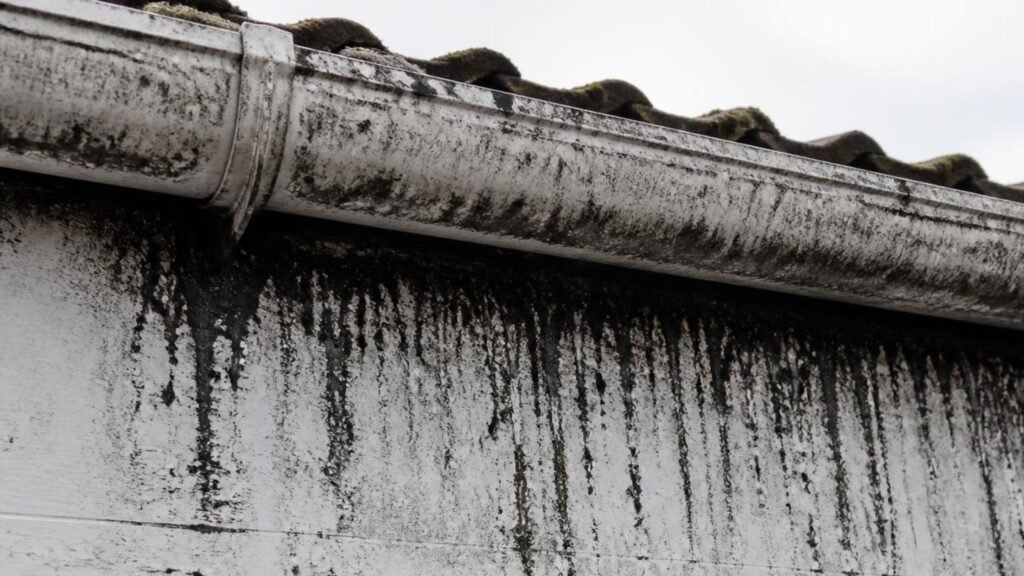
Black streaks running vertically down fascias are a separate issue. These come from dirty or partially blocked guttering, depositing contaminated overflow down the gutter exterior and across the surfaces below. If you have black streaks on your fascias, the guttering almost certainly needs attention at the same time.
On older UPVC, UV degradation can also contribute — extended sun exposure breaks down the surface layer slightly, producing a yellowish or chalky appearance. This is a change in the material itself rather than organic staining, and it’s harder to reverse than algae or dirt.
Can you clean UPVC yourself?
To a degree, yes. Warm water and a soft cloth will shift surface dust and the lightest grime from accessible frames and sills. White vinegar can help with very light algae if you can reach it easily. WD-40 comes up a lot as a tip for restoring shine — it does give a short-term improvement, but it isn’t a cleaning product and it pulls dirt back faster. The real limit with DIY is depth, not effort. You can clean what’s sitting on the surface, but what’s worked into the pores stays put. Using anything abrasive — stiff brushes, scouring pads — scratches the UPVC and opens the surface up, which means it stains more easily from then on.
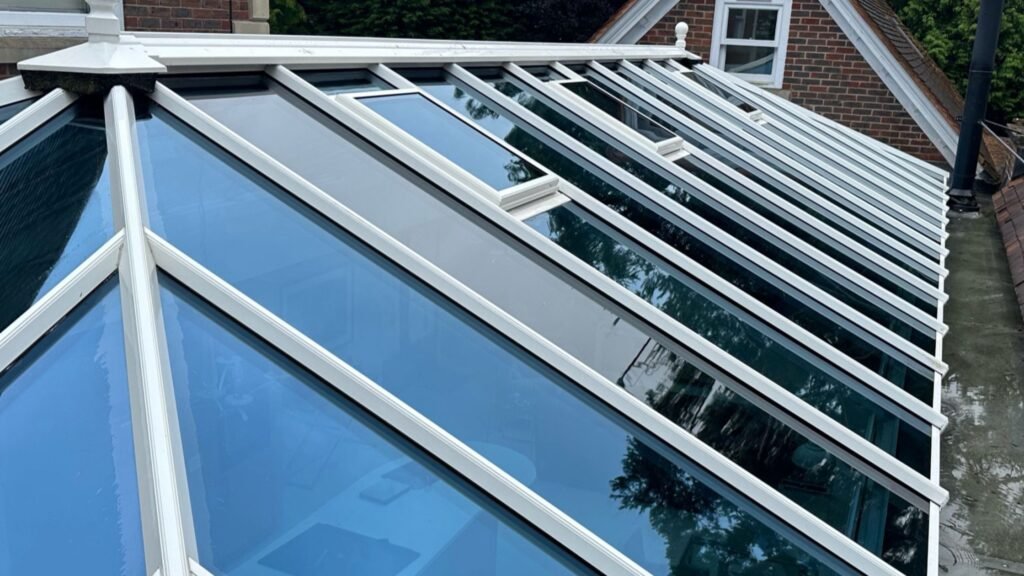
Reach is the other issue. A traditional ladder gets you part of the way on some jobs, but getting to first-floor soffits, high windows, sash windows and conservatory frames on larger properties without proper access equipment is genuinely difficult. The access challenges are more significant on semi-detached and detached houses with double-height fascias, bay windows or skylight windows — and on terraced houses in older streets where the roofline and gutter positioning adds another layer of difficulty.
What professional cleaning actually does
Professional UPVC cleaning uses biodegradable detergents applied using the soft-wash method — low pressure that lets the detergent do the work rather than relying on force. High-pressure jets around UPVC seals and joints can work water into places it shouldn’t be, so soft washing is the better approach — the detergent does the heavy lifting, not the pressure. The result is that the growth is actually gone rather than moved around, which is why it takes longer to come back. For fascias, soffits and anything at height, water-fed pole systems mean the whole job gets done from the ground — safer and better for reaching the spots where the worst build-up tends to be. On properties where that isn’t enough — unusual heights, awkward rooflines — a cherry picker fills the gap.
On larger or more complex properties where access requirements go beyond what a water-fed pole can reach, a cherry picker may be used. For most domestic properties across Cheshire, however, water-fed pole systems handle everything that needs doing.
How much does professional UPVC cleaning cost?
It varies with property size, the scope of UPVC across the property — frames, bay windows, conservatory windows, frames and sills, garage doors, sash windows and any cladding — access requirements and how much build-up there is. For a typical semi-detached or detached house in Cheshire, UPVC cleaning is usually bundled with window cleaning, fascia and soffit cleaning, or gutter clearing in one visit, which works out better value than booking each service separately.
As a rough guide, a standalone UPVC deep clean for an average house starts from around £40 all the way up to £150 if the property is larger with more UPVC. Combined with fascia, soffit and gutter exterior work it often works out more cost effective. Please remember though these numbers are just a guide, the most accurate way to find out what your property would cost is to get a free quote — prices vary enough between jobs that a ballpark figure without seeing the property isn’t particularly useful.
Is it worth it compared to replacement?
Almost always. A full set of UPVC window frames for a three-bedroom house runs to several thousand pounds, and adding fascia and soffit replacement pushes that considerably higher. Professional cleaning at a fraction of that cost restores the appearance significantly and extends the working life of the material. According to the British Plastics Federation, well-maintained UPVC can last 35 years or more — cleaning is part of what makes that possible.
The exception is very old UPVC with significant UV yellowing, where the discolouration is in the material itself rather than on the surface. Cleaning improves things but won’t fully resolve it. A reputable cleaning company will tell you honestly whether that’s the situation before any work is committed to.
How often should you get your UPVC cleaned?
For most properties in Cheshire, once a year is enough to stay on top of it comfortably. In more exposed or tree-lined locations where damp and algae build up faster — particularly properties close to water or in heavy shade — twice a year makes more sense. Seasonal demand is higher in spring and autumn, so if you’re planning a professional clean it’s worth booking ahead rather than leaving it until everyone else has had the same idea. If you’d rather not think about it at all, a regular maintenance plan takes care of the scheduling and keeps everything consistently clean throughout the year.
What about fascias, soffits and gutters?
UPVC frames don’t exist in isolation. Fascias and soffits are subject to the same organic build-up as your window frames, and guttering is directly linked — blocked or dirty gutters are the source of the black overflow staining you see on fascias below. Booking a combined clean — UPVC, fascias, soffits and gutter exterior in one visit — is more efficient and usually better value than treating them as separate jobs.
Book a UPVC clean in Northwich or Cheshire
If your UPVC has gone grey and you want to know whether cleaning will sort it, the answer for most properties is yes — and the difference tends to be significant. Take a look at our UPVC cleaning service, or get in touch for a free, no-obligation quote. We cover Northwich, Knutsford, Winsford, Alderley Edge, Hartford and the surrounding Cheshire area.