
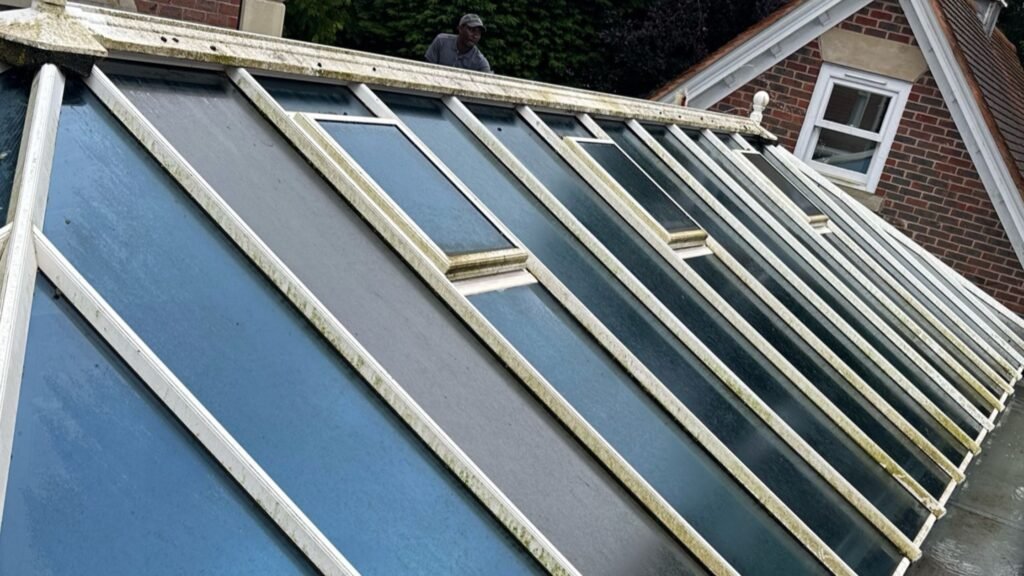
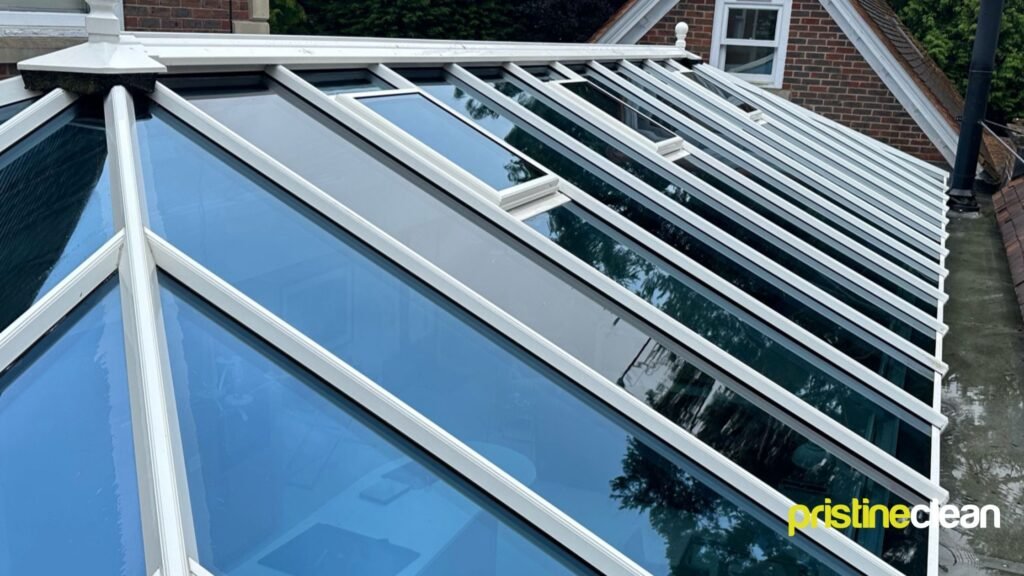
If your conservatory has gone from bright and clear to green and grimy, you’re not alone, conservatory cleaning in Cheshire is one of those jobs that creeps up on people. The polycarbonate roof darkens, algae works its way across the frames and the whole structure starts to look neglected rather than like an extension of the home.
In most cases it has nothing to do with the age of the structure. Dirt build-up, moss, algae and lichen are surface problems, and surface problems can be resolved. Understanding what causes them — and what professional conservatory cleaning actually involves — makes it clear why it’s worth doing properly rather than leaving it or attempting it yourself.
What builds up on a conservatory and why it matters
Polycarbonate roofs and glass roofs behave differently when it comes to soiling, but both are affected by the same combination of organic matter and atmospheric pollutants. Algae and lichen establish on the surface and embed into microscopic pits and scratches over time. Moss follows in the joins, edges and anywhere debris and moisture sit together. Atmospheric pollutants — fine particles from traffic, industry and agricultural activity — bond into the surface and produce the flat grey coating that makes glass look permanently dirty even after rain.
On polycarbonate roofs specifically, moss and algae degrade the material if left untreated. According to the Glass and Glazing Federation, regular cleaning and maintenance significantly extends the lifespan of glazed structures — neglect speeds up deterioration that would otherwise take years to develop. On glass roofs the build-up is more surface-level but equally persistent. UPVC and PVC frames are subject to the same green-grey biological staining as window frames and fascia boards.
Beyond appearance, moisture retention from moss and organic matter can work its way into joints and seals over time. Gutter maintenance on the conservatory itself is worth checking at the same time — blocked conservatory gutters behave exactly like blocked house gutters and cause overflow staining down the exterior.
What professional conservatory cleaning actually involves
The key difference between professional conservatory cleaning and DIY attempts is reach and method. Water-fed pole systems — using pure water fed through high-reach poles with soft brushes — allow the entire roof, frames and glass to be cleaned thoroughly from the ground. No ladders balanced across polycarbonate panels, no weight being put on the structure, no risk to the seals and joints.
High-pressure spray is not appropriate for conservatory cleaning. The pressure on polycarbonate roof panels and UPVC joints can crack panels and damage seals — the opposite of what you want. Soft brushes and pure water agitate the surface gently, loosening algae, lichen, dirt and organic build-up without abrasion. As the pure water dries, it leaves a streak-free clean with no residue and no smearing — noticeably different from what tap water and a cloth achieves, which tends to move grime around and leaves marks as the mineral content dries.
A full conservatory clean covers the roof panels — glass or polycarbonate — all UPVC or PVC frames, sills, exterior glazed panels and fascia boards. Where moss and algae treatment is needed first, eco-friendly, biodegradable detergents break down the biological growth before cleaning rather than just moving it around. Interior windows are a separate job: professional conservatory cleaning is exterior only, and the interior glass is straightforward to manage from inside with a standard glass cleaner.
How much does it cost and how often should you book?
Cost of cleaning varies with the size of the conservatory, roof type, build-up levels and access requirements. A standard lean-to or Victorian conservatory on a domestic property in Cheshire typically runs from around as little as £30 up to £100+ if its a HUGE conservatory. Larger Edwardian or P-shaped conservatories, or those with heavier soiling, sit at the higher end or above it. The most accurate way to find out is to get a free quote — it varies enough between jobs that a figure without seeing the structure is rough at best.
How often should you get it cleaned? Whenever it starts to get dirty, many of our customers get it cleaned every 3 months, some can easily have it done one or twice a year. If you conservatory sits amongst overhanging trees the debris and moisture onto the roof builds up faster so more regular cleaning is needed. This regular cleaning prevents the heavy build-up that takes significantly more time and treatment to shift, which keeps the cost per visit lower over the year. We also clean conservatories as part of commercial properties.
Book conservatory cleaning in Northwich or Cheshire
If your conservatory roof has gone green and the frames are looking tired, a professional clean sorts it in one visit. Take a look at our window cleaning, UPVC cleaning and roof cleaning services for what else we cover, or our maintenance packages if you’d rather arrange regular visits and not have to think about it. We cover Northwich, Knutsford, Winsford, Alderley Edge, Tarporley, Hartford and the surrounding Cheshire area.